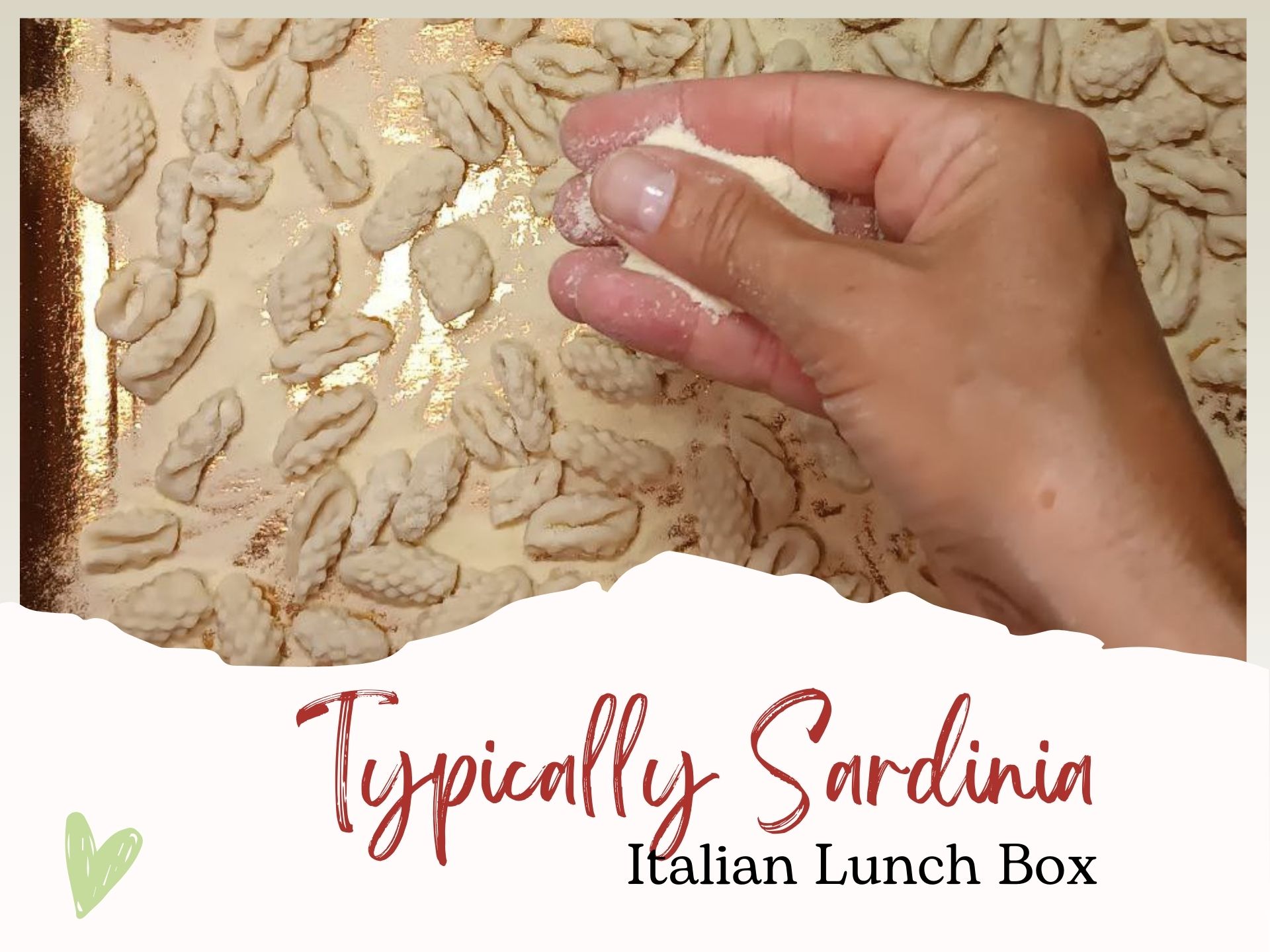
Today – for the Italian Lunch Box – we’d like to talk about some very comforting fresh pasta: the “Chiusoni galluresi” [kiu-sò-ni gal-lù-re-si], a type of artisanal handmade dumplings typical of Gallura (Italy), where our “Traveling Chef Simona” is now.
Welcome to our plant-based recipes collection – the fruit (and veggies) of a collaboration between ottimoblog.com and appetibilis.net | Here happily edited and translated by Orsola 😀
“Let’s start by saying that, on my mother’s side, I’m originally from Gallura (a north-eastern part of Sardinia, the biggest Italian island), and most of my family still lives there, in the charming town of Santa Teresa Gallura.
Having said that, my father (widower) has a partner, Francesca — Gallurese DOC (*) — whom I asked for historical clarifications on Chiusoni; that, in my opinion, is not even spelled that way, but at least we understand each other!
(*) DOC (Denominazione di Origine Controllata) Controlled Designation of Origin, is an acronym borrowed from the wine world, that guarantee the quality and authenticity of local productions.
![The Italian Lunch Box | Typically Sardinia [banner]](https://i0.wp.com/appetibilis.net/wp-content/uploads/2024/08/Typically-Sardinia-banner.jpg?resize=1000%2C333&ssl=1)
What are Chiusoni
What are Chiusoni? It’s a type of fresh, handmade pasta (in the realm of dumplings): small cylinders (3 – 4 cm) with a rather irregular shape and a rough surface, looking very much alike small gnocchi [Nyòk-kee].
It turns out that they’re traditionally made on the first of August – to celebrate new wheat — dressed with a “sughetto di pomodoro semplice” [su-get-to di po-mo-dò-ro sém-pli-che] (fresh tomato sauce), topped with some fresh basil, and we’re good to go!
On the magic combination of flour and water! There is an active debate about the type of flour that should be used. The question is: “semola rimacinata” (re-milled durum wheat semolina) or Italian “type 0” flour (all purpose)?
To help us settle the matter, Francesca’s sister explained that white flour (the type 0) has always been the flour of choice, however, now many people use semolina or a combination of both.
In reality, according to them, semolina was used solely to dust the trays on which the freshly made Chiusoni were placed. In short it served the purpose of drying out any moisture or ‘stickiness’ between them.
How semolina was upgraded to the main ingredient is unknown, but I tested it both ways and I must say that all purpose flour wins big time!
Recipe for Chiusoni Galluresi
Time to get to the recipe for Chiusoni Galluresi.

[servings: 5 | total time: 25 min. | difficulty: easy]
| Please note that the info and directions provided for the recipe are indicative: the end result may vary from person to person |
Ingredients
- 400 g all purpose flour
- 200 mL hot water
- 1/2 tsp sea salt (fine type)
Useful tool
- A fresh pasta (pastry) board
- An open style grater (check the pick on the right-hand side of the banner below)
- A tray
- Some semolina flour to avoid Chiusoni from sticking to each other.
- a kitchen scale with g and oz would be perfect.
Directions
- Place the flour on the pasta board to form a well; that is, make a mound and open a crater in the middle, where you’ll pour the water. (You could use a bowl to start with).
- Pour in the water a little at a time (*) until you get a nice smooth (pliable) dough, that’s not too hard.
- Now it’s time to shape Chiusoni. Split the dough into six pieces, and place a damp paper towel over the ones you’re not using (to keep them moist).
- At this point, knead the dough (you’re working with) few times, then roll it into a medium-long log (about 1/2 cm thick). Cut equal sections, cylinder-like pieces.
- To get the typical roughness of Chiusoni, just roll each chunk over the back of a grater (a fork or gnocchi board would do too). No indentation please, it wouldn’t accomodate and hold the sauce that well.

- Arrange them on a tray sprinkled with some semolina, and patiently keep rolling the rest of the gnocchi.
- To cook. Plunge them in batches in plenty of boiling salted water, and, as soon as they rise to the surface, let them cook for 5 – 7 minutes. (Taste one to ensure it is cooked through).
- Drain and season/dress the Chiusoni immediately. A fresh tomato sauce (or a garlic-based sauce) is perfect, topped with a generous amount of our plant-based grated cheese… Check the recipe for Ottimo grattugiato, it’s so easy.
- Finish the dish with a couple of fresh basil leaves, and few drops of oil (*).


Notes & Variations
- About the oil (*) – Unless otherwise specified, we may use organic and cold-pressed evo oil, or sunflower seed oil (the high-oleic type for frying).
- As with any fresh dough, the amount of water will vary depending on the type of flour you use, so don’t worry if it’s a little different each time!
- Regarding the ingredients measurements. I know you’d prefer something more “precise”, but that’s what Italian ways of cooking are all about: prepping/cooking n “sailing by sight” most of the time 😜
- In this case, I started with just over 1/2 cup of hot water (about 200 mL), salted with 1/2 teaspoon of fine salt.
- If you’d like to try-out Chiusoni made with semolina, just substitute the flours and good luck!
More on Pasta Lovers


Cucina, corsi, oli essenziali.
Insegno a cucinare in modo sano, testo e invento ricette “plant based” anche in video.
Scrivo racconti di cucina e non solo.
Cuisine, cooking lessons, essential oils.
I teach healthy cooking, test and create “plant based” recipes, also on video.
I write about food, and other stories.