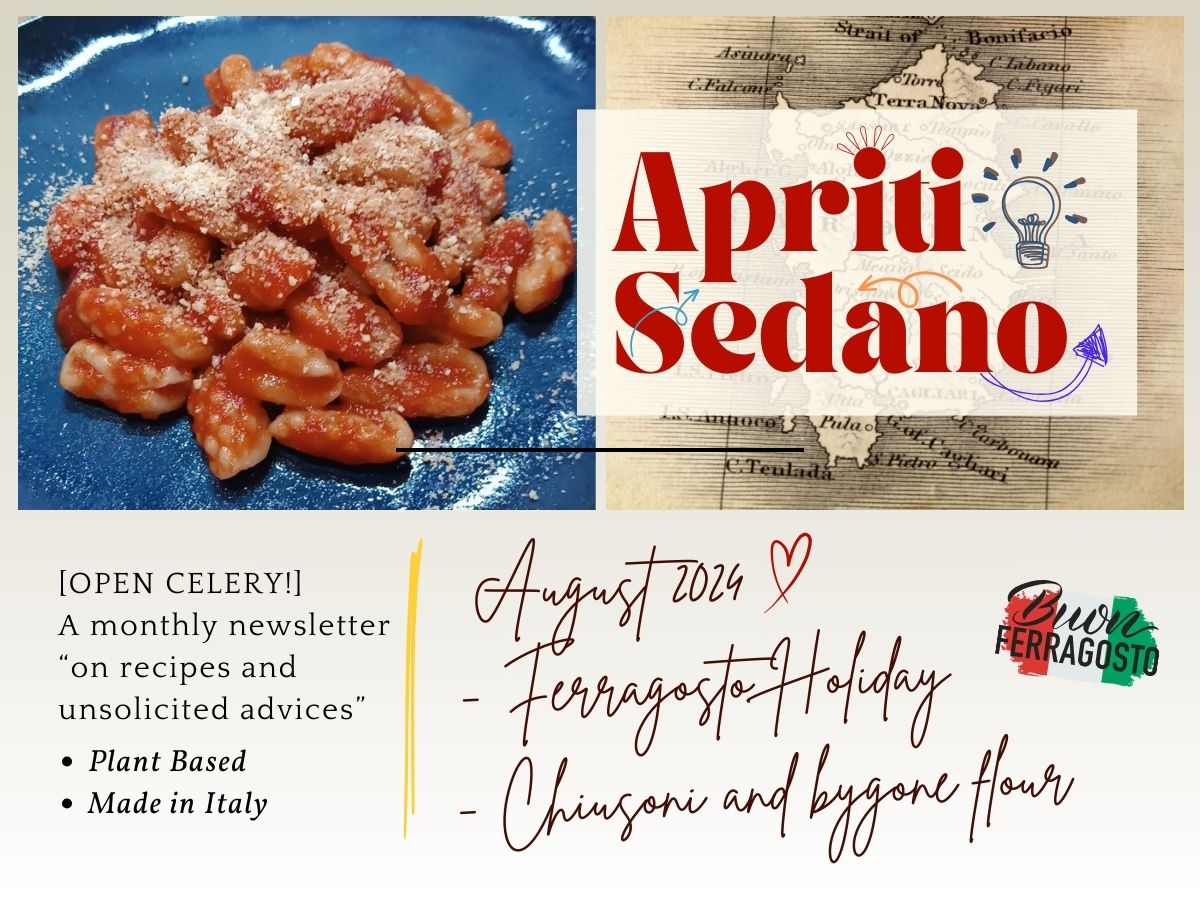
Here it is, the watershed that – following our Italian tradition – inexorably separate the “before and afterwards” of each year: we’re talking about Ferragosto and… the bygone flour.
The time “before” represents an ascending climax that leads into the peak of summer! “Before” is full of anticipation for the coming vacation time, the sea waiting to be explored, and the mountain just waiting to be discovered, with the possibility to wear a sweater in the evening! The heat is usually unbearable at this time 😵💫
Welcome to “Open Celery!” our monthly newsletter on plant-based recipes, stories and unsolicited advice made in Italy… The fruit (and vegetable) of the collaboration between ottimoblog.com and appetibilis.net
Published in Italian and English (and happily edited and translated by Orsola)… at some point, we’d like to have it in podcast as well 😀
(Cliccate qui per “Apriti Sedano!” in italiano)
“Before” is full of possibilities and excitement for whatever that’s yet to come. Then Ferragosto arrives, the great lull, when (in Italy) everything standstill! It’s like a pause that follows the crescendo and gives the musicians an opportunity to catch their breath, and the listeners a chance to unwind.
For a moment everything stops in the summer heatwave, and you don’t know what lies ahead: will the “afterwards” descent be gentle or sudden.
Once in the “afterwards”, you feel that September is at the door, with its chestnuts, and the crackles of autumn fireplace, doesn’t matter if it’s still 35 °C.
Back-to-school time is around the corner, the knee socks and “health t-shirt”(*) are calling from the drawers… if you, like me, got everything mixed together in one palce 🫣
About Ferragosto
But let’s talk about the “great lull” that is Ferragosto in Sardinia. As in the rest of Italy, we eat and drink: in Sardinia we drink primarily, thought we eat too. And, from the stories of my father’s partner who is a Gallurese DOC(**), it looks like on August 15 the locals are repeating the custom of eating Chiusoni galluresi (an artisanal fresh type of pasta) dressend in freshly made tomato sauce, and few leaves of basil just picked from the seedling. A custom borrowed from August 1 (the day they celebrate the new wheat).
Just a quick note about Ferragosto. The name actually comes from the Latin “Feriae Augusti,” (Augustus’s Holidays). It was a festival in honour of the first Emperor Gaius Julius Caesar Octavian Augustus (18 B.C.) who – apparently – also gave the month of August its name.
The Romans were celebrating it on August 1 with the “Consualia,” marking the end of the harvests and the work in the fields. Isn’t it fascinating that on this day, new wheat is still celebrated in Gallura by making “Chiusoni”?
It wasn’t until the 7th A.D. that the holiday was moved to August 15, and dedicated to the “Feast of the Assumption of Mary” (a Roman Catholic Holiday).
![Italian Summer [banner]](https://i0.wp.com/appetibilis.net/wp-content/uploads/2024/08/Italian-Summer-app.net-banner.jpg?resize=1000%2C333&ssl=1)
About Chiusoni from Gallura
About Chiusoni from Gallura (a gorgeous area in the North-Eastern part of Sardinia island). The [kiu-sò-ni gal-lù-re-si] it’s a type of fresh dumplings looking very much like gnocchi.
On the quest to the original recipe, I started by asking Francesca (my father’s partner), and she provided insight into the evolution of the main ingredient: the bygone flour.
Once upon a time, there was no distinction between 00/0/1/2 flour’s types. When you sent your kids to the grocery store you’d just say “… get a package of flour, please” because that’s all you could get.
It’s also true that, according to Francesca, they often milled their own flour from nearby wheat, so that was it, you couldn’t go wrong!
Of one thing she was absolutely sure, though: no “semola” (semolina flour) was used to make the Chiusoni! The semola was only for drying, placed under the gnocchi so that they wouldn’t stick together.
I decided for a quick web search and found out that today semola is the main ingredient in and around Chiusoni. When I said this to Francesca, she raised her eyebrow and replied: “That’s because we always end up copying from others”. She’s referring to the well-known culurgiones (a fresh stuffed pasta), which, however, are from Ogliastra (Central-Eastern Coast of Sardinia).
I tested the recipe both ways and found that the version with “0” flour (all purpose) was clearly the winner. After all, Francesca’s eyebrow input is worth far more than any recipe you’ll find online!
If you’re not sure about it, just try these plant-based recipes yourself:
- Li Chiusoni galluresi
- and li Culurgiones dell’Ogliastra (the recipe is in Italian)
Happy “Feriae Augusti” !
Notes
- (*) In Italy the “health t-shirt” is an item of clothing (looking like a tank top). It’s usually worn under a shirt, to protect against possible cold snaps, during the cold months.
- (**) DOC – “Denominazione di Origine Controllata” (designation of controlled origin). It’s the acronym borrowed from wine field, that proves local quality and authenticity.


I’m an Italian gluten-free Gourmet Traveler+ and a passionate storyteller, writing in English and Italian. Fluently speaking (eating and dreaming) in Italian, English, French, and Russian. When I’m not writing, I cook and test recipes for special diets, and photograph (also on film). Not necessarily in that order. — / — Sono una viaggiatrice buongustaia (la Gourmet Traveler+) senza glutine, appassionata narratrice di storie. Scrivo in italiano e inglese, parlo (mangio e sogno) fluentemente in italiano, inglese, francese e russo. Quando non scrivo, cucino, testo ricette dolci e salate per diete speciali, fotografo (anche in pellicola). Non necessariamente in quest’ordine.