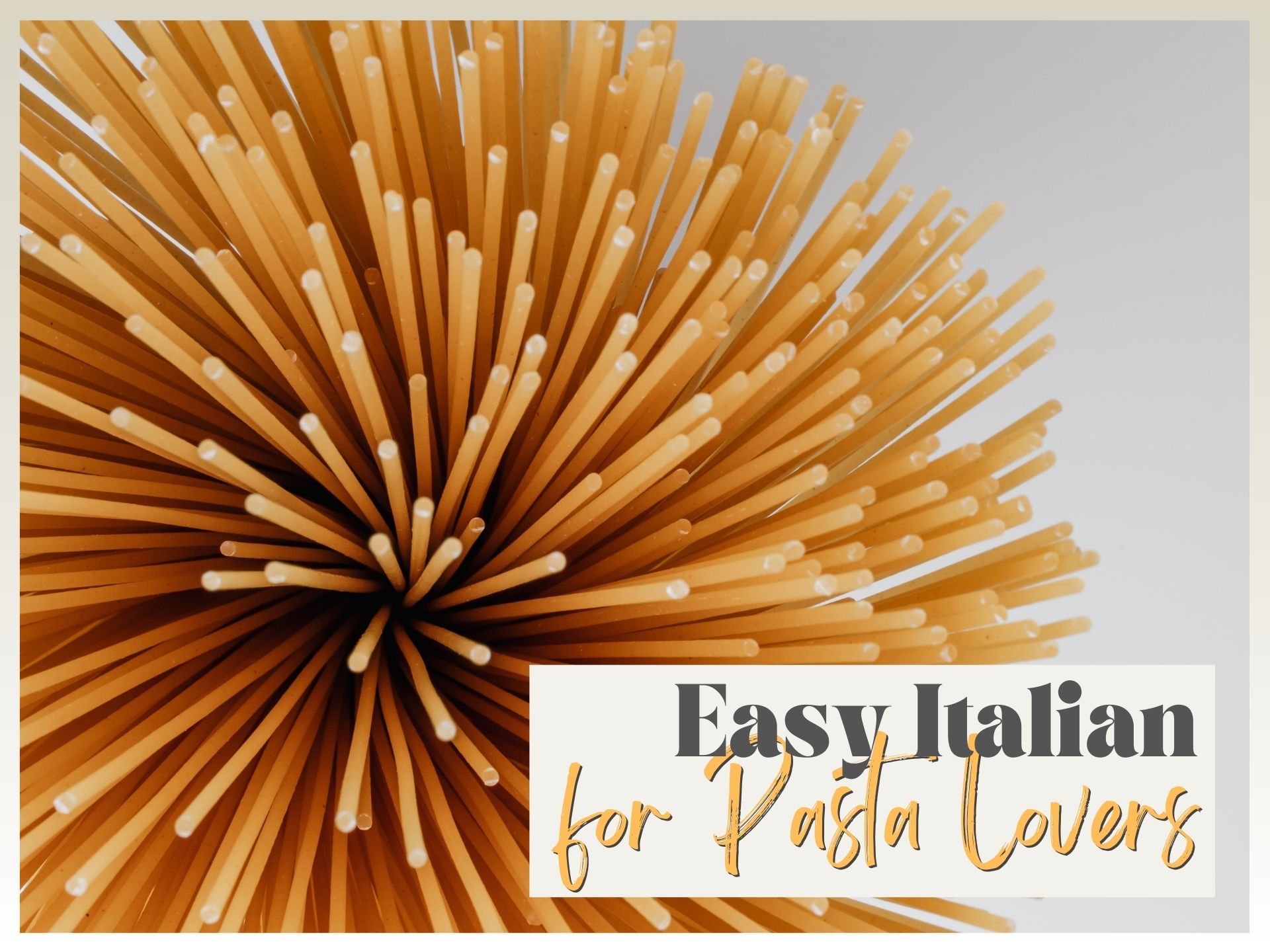
For pasta lovers is always a good time for some Easy Italian: What about Spaghetti?…
The pasta lovers know that an Italian meal is like an opera: it starts ‘andante’ and builds up ‘con gusto’ with each course bringing you closer to… an espresso (or two). Apparently it helps digestion 😉
Ahh, what would we do without pasta or coffee!
Pasta is generally the ‘primo piatto’ (first course) of this opera; it comes right after the ‘antipasto’ (appetizer or starter), and is served as a dish in its own right.
It’s a standalone followed by a ‘secondo’ (main course), a ‘contorno’ (side dish), and ‘dolce, frutta e caffè’. (dessert, fruits and coffee).
Typically, this works for a formal/holiday feast, would be way to much for everyday meals, don’t you think so?
A word (or two) on spaghetti
As often happens in our Italian culinary traditions, there are no set formats in pastas, and the names greatly vary between the regions. But spaghetti is spaghetti!
– Please note that for the purpose of this article I’ll use the third singular, referring to spaghetti as pasta. But, when in Italy, you’ll have to use the plural masculine 👍 –
When it comes to spaghetti, there’s no doubt: regular or square, thin or thick, this pasta is a pantry staple of Italian cuisine. It’s within the category of ‘pasta lunga’ (long pasta), and it comes in different sizes to suit different recipes: matching pasta with sauce.
In order to be called spaghetti, (spaghettini or spaghettoni), the pasta has to be shaped like a long, variably thin, string(*):
- 25 cm in length (that’s the contemporary standard), instead of the original 50.
- The thickness wary from 1-1.2 mm to 1.8-2.2 mm.
(*) About string. In Italian is called ‘spago’ [spà-go] hence spaghetto (little string). And spaghetti is the plural of spaghetto 🤓
Here are few of the names we use to identify some of the spaghetti like pasta:
- On the thin side – besides spaghettini – we got capelli d’angelo (angel hair), Capelvenere, Fidelini, Sopracapellini…
- On the thicker side we have spaghettoni, filatelli, vermicelli (little worms) and vermicelloni (thicker worms); Bigoli and Pici are an artisanal version.
- Then we have the ‘Spaghetti (tonnarelli, or maccheroni) alla chitarra’ (guitar spaghetti).
The maccheroni alla chitarra are named after the guitar-like device used to cut the pasta. A wooden frame strung with metal wires (like on a guitar), where sheets of pasta are pressed down with a rolling pin, so the strings of pasta are falling through. In this case are squarish.
![Easy Italian: Cooking spaghetti in biling salted water [banner]](https://i0.wp.com/appetibilis.net/wp-content/uploads/2024/09/Easy-Italian-Spaghetti-in-water-banner-1.jpg?resize=900%2C300&ssl=1)
About the gluten-free version
For time being, we have one size spaghetti, the medium one, and we happily make-do with what we have. Although, different brands perform in different ways…
‘Chi si accontenta gode!’ (Enough is as good as a feast!)
Easy-Peasy Italian ‘Sciué Sciué’
In the vast Italian pasta recipes collection we have a rich portion dedicated to ‘ricette Sciué Sciué’ [shoo-é shoo-é] quick and easy recipes… fast food the Italian way! 😜
‘Sciué Sciué’ comes from the Neapolitan dialect, typically meaning a way of being unrefined, superficial or sloppy. Yet, when transposed into the culinary world, it denotes something simple and quick, not very elaborate, prepared with few ingredients (scraps and leftovers included), though natural and genuine.
Within the Italian quick and easy recipes reservoir, most often than not, spaghetti is the pasta of choice: ‘ci facciamo una spaghettata?‘ (Shall we have spaghetti?).
All you have to do is boil some salted water, throw in the pasta and, while is cooking, concoct a sauce. There, you have it!
The ‘spaghettata’
The ‘spaghettata’ (spaghetti meal) can be enjoyed on your own or among friends, for lunch, dinner or as midnight snack, and it’s mostly improvised and done without formality.
It’s the perfect quick, easy and cheap meal. It relies on Italian staples like pasta (of course), garlic, oil, chilli peppers, tomatoes and fresh basil. The remedy when we’re in a rush, or have unexpected guests and need to fix something 😮
Here I’ve put together a list of some of our deliciously easy-peasy Italian recipes, also super quick to make… the fastest one being ‘spaghetti aglio, olio e peperoncino’.
‘Ci facciamo una spaghettata?’
[chi fa-tchià-mo una spa-gét-ta-ta]
(Shall we have spaghetti?)
- Check our super easy recipe for Spaghetti with garlic, oil and chili pepper, a beloved dish that we could eat at any time of the day.
- Spaghetti & Broccoletti… (broccoli rabe), a delightfully bitterish dish, a cornerstone of Neapolitan cooking.
- Spaghetti alla Chitarra that strikes the right chord… a pasta lover must-try!
- Maccarunə Carrati Frittata… one-dish meal, usually made out of pasta leftovers, eggs and whatever you have.
- Rintrocilo with Black Truffle… a lusciously chewy pasta, the water and flour version of chitarra.

The Pasta Ways
We have two ways to prep pasta:
- Pastasciutta (literally dry pasta), covers all those recipes that call for a dense, creamy sauce, to be cooked also ‘al forno’ (baked): lasagna is a great illustration of ‘pastasciutta al forno’, and
- Pasta in brodo – pasta in broth is the antonym of pastasciutta, since it requires a broth (precisely), a soup, a bouillon in which to serve the pasta.
An Italian meal is like an opera: it starts ‘andante’ and builds up ‘con gusto’ with each course bringing you closer to… an espresso (or two). Apparently it helps digestion 😉 Ahh, what would we do without coffee!
When we talk about spaghetti, we usually think of pastasciutta. Unless we are out of pastina (small size pasta) for soups, and we ending up breaking the ‘strings’ which fit the purpose wonderfully, especially for pasta e fagioli, trust me!
Spaghetti (the medium one) – compared to other sizes – is the ultimate all-purpose pasta.
It’s the perfect choice for thousands of condiments: from the popular garlic, oil and chilli peppers to puttanesca sauce, tomato and basil, vongole, and all vegetable-based sauces (courgettes, pesto, peppers, etc.), being with ‘sughi rossi or bianchi’ (red or white sauces)*… And, in case of leftovers, it makes a scrumptious omelette.
* Red sauce feature the ubiquitous tomato, the white one no!
About ‘in bianco’
Pasta ‘in bianco’ is the epitome of simplicity. It’s the ideal pasta for those hectic days when you’ve got no time for shopping, there are no tomatoes in sight, or the fridge is empty and hunger is calling for dinner.
– Please do not translate ‘sugo bianco’ as plain sauce: it’s a white sauce and is anything but plain! It’s a type of condiment that might take a little practice and cooking know-how to prep it properly, but it’s worth it. –
- A simple pasta dish dressed with aglio, olio e peperoncino is one example of pasta in bianco.
- Another is pasta sautéed with butter (maybe a sage leaf), and any grated cheese available.
Pasta in bianco it’s one of the ultimate Italian comfort food: quick, filling, and warming… happy times!
If you want to know more about Italian lingo with ‘in bianco’, check this Appetibilis Glossary article: Letter “B”: (in) Bianco
“The first condition of understanding a foreign country is to smell it.” (Rudyard Kipling)
The Art of Twirling Spaghetti
Eating a plate of spaghetti can be a challenge, I know. Ultimately, we have been eating spaghetti for generations and – somehow – perfected the art of twirling spaghetti around a fork, without needing additional utensils (like a spoon)… OMG 😰 it’s time to twirl!
![A skein of spaghetti on a fork | Easy Italian: The Art of Twirling Spaghetti [banner]](https://i0.wp.com/appetibilis.net/wp-content/uploads/2024/09/Easy-Italian-Twirling-Spaghetti-on-a-fork-banner.jpg?resize=900%2C300&ssl=1)
Here are the basics:
- Holding the fork is a bit like keeping a pen for writing, you position it between the index and the middle finger, and hold it with your thumb.
- Then, make some space in the dish by gently pushing the pasta on the side (just a bit),pull some spaghetti in the free zone – 4-5 strands should do – and start to ‘twirl and pool’ clockwise (that’s the easiest way).
- pull some spaghetti in the free zone – 4-5 strands should do – and start to ‘twirl and pool’ clockwise (that’s the easiest way).
- For experts only – Try the counter-clockwise, for fun. It could be messy though, especially with bucatini, but this is for another story
- Also, beware of untidy forkful, if too big better drop the skein and start again 🙌
- In case you feel spaghetti being too long, don’t despair and keep twirling until the strands are wrapped around the fork.
-Please don’t cut spaghetti, except for very young children-
Even if the twirling may cause an ‘Allegro ma non troppo’ mood (Cheerful but not overly so), as music for catching the right movement, I’d suggest a waltz.
Just imagine listening the 🎶 ‘Jazz Suite No.2: VI. Waltz 2 by Dmitri Shostakovich’ and… 🎶 Twirl and Pool… Twirl and Pool…
That’s all for now.
Thank you very much for reading all way down here, I really hope this article is going to be helpful. And, in case you’ll try any of our recipes, please let us know how they turned up. Meanwhile: ‘Buon Appetibilis!’


I’m an Italian gluten-free Gourmet Traveler+ and a passionate storyteller, writing in English and Italian. Fluently speaking (eating and dreaming) in Italian, English, French, and Russian. When I’m not writing, I cook and test recipes for special diets, and photograph (also on film). Not necessarily in that order. — / — Sono una viaggiatrice buongustaia (la Gourmet Traveler+) senza glutine, appassionata narratrice di storie. Scrivo in italiano e inglese, parlo (mangio e sogno) fluentemente in italiano, inglese, francese e russo. Quando non scrivo, cucino, testo ricette dolci e salate per diete speciali, fotografo (anche in pellicola). Non necessariamente in quest’ordine.