Why Campo Imperatore (l’Aquila) is a great ride on mountain bike…
… Campo Imperatore (l’Aquila) :: A great ride on mountain bike
Why Campo Imperatore (l’Aquila) is a great ride on mountain bike…
… Campo Imperatore (l’Aquila) :: A great ride on mountain bike
“I usually go hiking and I see landscapes change around me. Just for a change, I remained still and let the landscape come towards me.” ~Lonza65 … Time Lapse: The Majella Massif

This summer too, is coming to a close; the longest and hottest ever. We will miss it, because, as Ennio Flaiano said:
… Fine Estate :: Photos de Voyage“There is only one season: summer. So gorgeous that the others ring around it. Autumn recalls it, winter beseeches it, spring envies it and childishly tries to spoil it.” ~Ennio Flaviano

Food Photography 101: experts reveal tips and tricks on capturing alluring pictures of food…
… Food Photography :: On capturing best foodie pictures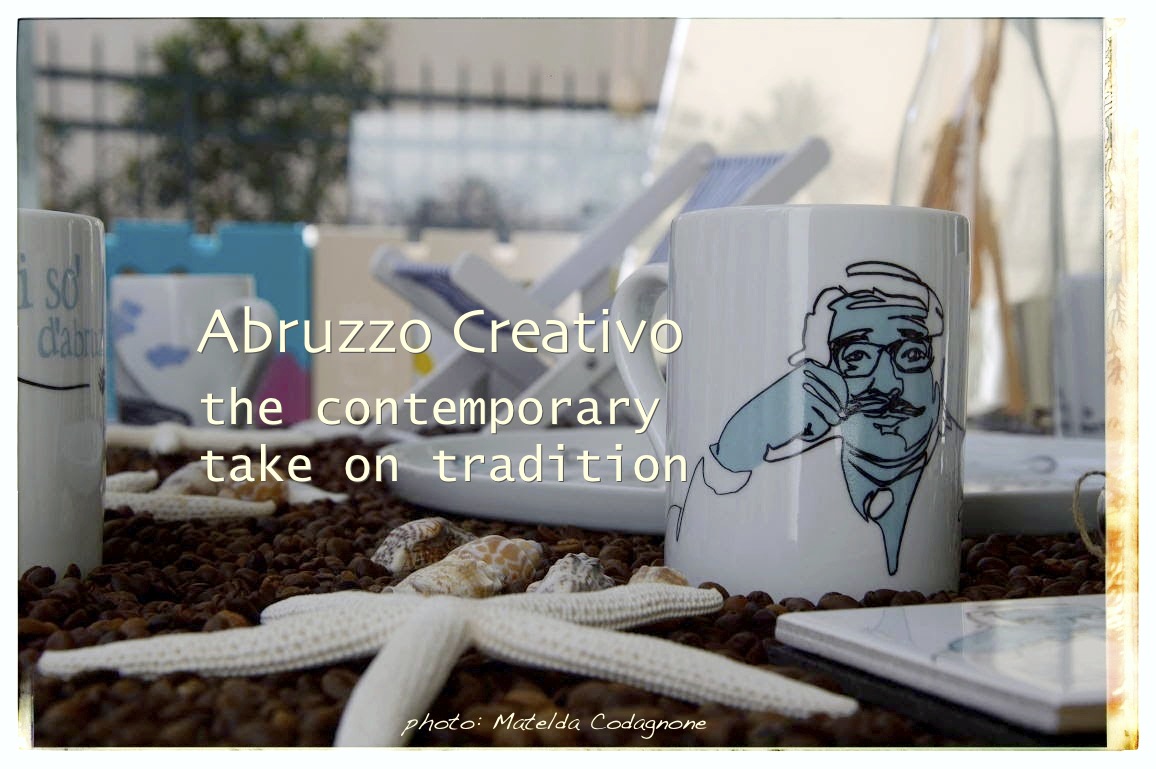
Ode to the Made in Italy: AbruzzoCreativo, contemporary design heritage-n-tradition… What do Fellini’s favourite scriptwriter, an exquisite filigree jewel and a typical fishing device like the trabocco have in common?

Ode to the Made in Italy: AbruzzoCreativo, New-Fashioned Heritage…
They are all icons from the same region, Abruzzo, and they feature “Abruzzo Creativo” items. The mind behind the brand is Paola Mucci, an architect by trade and a creative soul at heart. Paola is deeply in love with her region (the Abruzzi), where traditional heritage is still strong and cherished by their people.
Architect Paola Mucci @ her Abruzzo Creativo Workshop in Pescara | Presentosa Glassware Collection

The first idea came from the Taranta blanket, a woollen matted fabric that is manufactured in the village of Taranta Peligna, Chieti. Paola’s intent was to use its unique pattern and weft in furniture design, but its exploitation proved to be difficult.
The creative spark fired after a trip to Sardinia. Sardinia’s crafts and cultural floklore have been updated in so many different ways. Why not to try with Abruzzo? These two regions share many traditional features and the bottom line was to rethink the cultural heritage of the land into a modern way. “Tradizione contemporanea” – new-fashioned heritage – was the the right key and production started with “the mug” series.

Mugs show Abruzzo icons: Ennio Flaiano’s portrait – journalist, humorist and Fellini’s best scriptwriter, the Presentosa – a filigree pendant jewel – and the trabocchi, (a fishing device). The challenge is to bring up to light Abruzzo treasures, especially the ones that are little known and even less promoted. A natural outcome of this is the “Provincia” series, four mugs bearing four “hidden” treasures of each Abruzzo province: Roman mosaic floor in Vasto, Atri Cathedral rose window, Scanno typical women’s dress and Pescara Ponte del Mare (i.e. Sea bridge).

The path was set and Paola thought about new subjects, all of them with a strong and direct link to her region: Bruno the brown bear, the sheep and the “papalina” (a type of oily fish) and kitchenware production includes walnut chopping boards, glasses, pot mats, and coffee cups.

Abruzzo Creativo knows how to combine long-standing cultural heritage with a modern style; because only if you know your roots, you will be able to express yourself in an original way. And that is exactly what Abruzzo Creativo does with its products.


“Why do we think love is a magician? Because the whole power of magic consists in love. The work of magic is the attraction of one thing by another because of a certain affinity of nature.” ~Marsilio Ficino

In a stunning mountain area of Abruzzi little known to foreign visitors, within the province of Chieti [Kieti], there is the beautiful town of Pretoro – population 949. It is thought that an ancient settlement existed during the Bronze Age, whereas the current fortified borough was established sometime in the XII century…


On the world’s most popular e-commerce site you can buy a humorous tee with this slogan joke: ” I don’t need Google. My wife knows everything.” If Amazon people were from Pretoro, a village in the Abruzzo region, they would change the joke into: ” I don’t need Google. Zi’ Tunin’ (Uncle Antony), knows everything.”
Zi’ Tunin’, age 84, however, is far better than Google and Wikipedia: not only does he master a huge amount of information, but he gives it to you with the openness and the simplicity that only wise men can have.

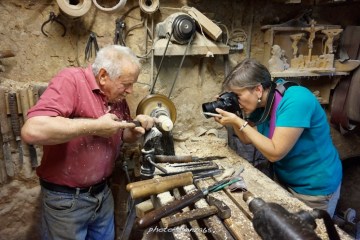
Zi’ Tunin, aka Antonio Palmerio, worked for years in a local company as a carpenter (and as many more other things). Since childhood, he has always had a deep love for knowledge and he devoured all the books he could lay his hands on. Unfortunately for him, his parents could not grant him a higher education so he stopped shortly after primary school. This did not prevent him from becoming a living encyclopaedia. His longing for knowledge and books has made him proficient in many subjects, chemistry, architecture, art, literature. When he retired, he could combine all his passions together into woodworking.

Visiting his workshop on the highest “contrada” (city area) of Pretoro is something difficult to explain, half way between an art history lesson, a visit to a museum and a conversation with an all-around master.
He is fond of architecture and his hobby is to make toy models of the most famous Italian and European buildings: the Duomo of Milan, Notre Dame in Paris, Saint Anthony from Padua Church, you name it.

I asked him if he would like to visit the monuments he copies and surprisingly – to me – he said he would not. Except for a couple of trips to Switzerland, Zi’ Tunin has never moved from Pretoro. He is satisfied with his village and his hobby, he says. He can easily make copies of statues, bas-reliefs and human shapes, and he is one of the last artisans left who can make wood spindles for bobbin lace.
A talk with Zi’ Tunin is quite an experience. He can equally talk to you about chemistry and apple tree grafting – as far as I’m concerned I could not say anything sensible about either subject – without any hubris from his side: he is just happy to share what he knows.

Before saying goodbye, I asked him what he would have liked to be if he had had the chance to go on his education at school. I imagined that he wanted to be an engineer or an architect, because of his love for buildings and architecture. He took me by surprise and said he would be a philosopher because philosophy is the love for knowledge. All he knows he learned from books, and the process is still going on, even at 84.
The world may have lost a great thinker, but it has gained a life coach.




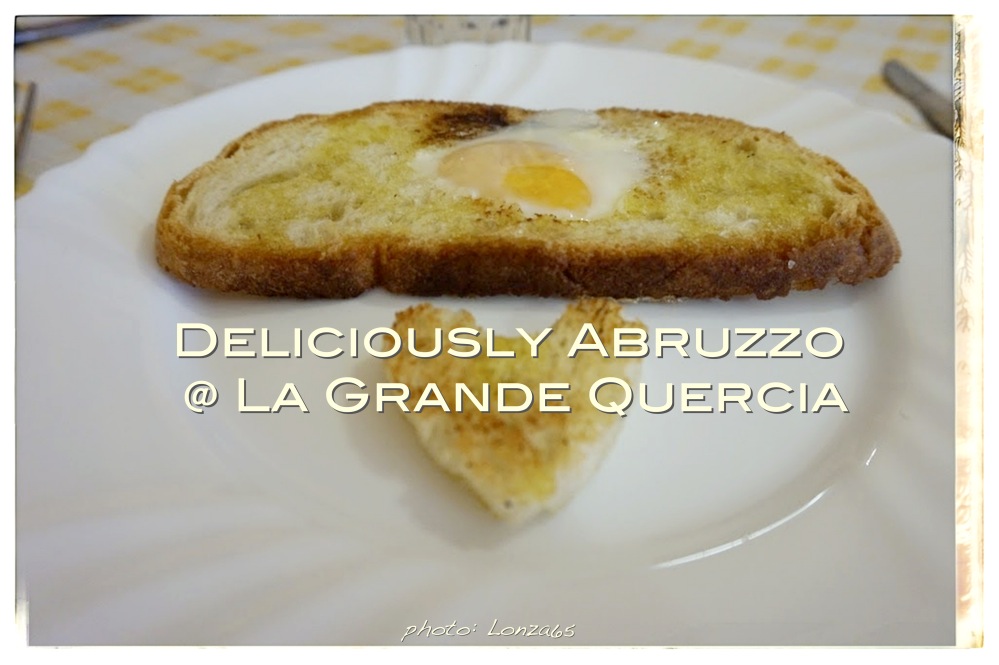

At La Grande Quercia, dishes follow season cycle, so menus change according to the produce available. Don’t forget to ask for their signature lamb dish, “agnello incaporchiato” [anyello incaporkiato]. It requires a few ingredients: a leg of lamb, extra-virgin olive oil, white wine, rosemary, a couple of cloves of garlic.

This recipe comes from the old days when people did not have meat very often, so when there was the chance to cook it, they used to put another pot on top (incaporchiato), so that the smell could not go out and tell the neighbours that something good was on the stove. At La Grande Quercia a heavy lid is used instead, and the stewing is perfect.

The true secret is mamma Maria’s cooking mastery – and the weight of the stones…


Read more about La Grande Quercia :: Harvesting time and family recipes

What happens in Bomba, a village of scarcely a thousand people in the Sangro area (Abruzzo), when a big wedding is on the way? It’s a Pasticciotto’s Story!
… The “Pasticciotto” Ladies from Bomba (Abruzzo)

Since I was a child, summer has always been the synonym for two things: school term end and harvesting time. Now that school days are – alas! – a faraway memory, harvesting time still retains its fascination to me, who I was brought up in a small village and I spent my summer vacations at my grandparents’ house in the countryside.

Recently, I had the chance to watch harvesting machines at work in the countryside around Atessa, in the acreage surrounding La Grande Quercia agriturismo (farm restaurant, i.e. a business that raises, grows and cooks its own poultry, livestock and vegetables). A quintessential locavore stop.
The name comes from the majestic oak tree just in the middle of the yard – legend says that the oak offered shelter to the Borbonic troops in the XIX century – but the area surrounding the building is worth to be looked at, too. In front of you, hillsides covered with wheat, interspersed with brush spots and olive tree plots and the village of Atessa just behind your shoulders. My idea of wheat field had to be rethought: how can you call a “field” a stretch of land that is as steep as a mountain slope?

Nowadays harvesting is carried out by means of harvesting machines, which save time and exertion. The job a machine can do is far more quicker than a handful of toiling and sweating man. However, the spirit of this activity remains unaffected: “as you sow, so shall you reap” is to be meant literally.

Lunch break at La Grande Quercia is quite and experience. My suggestion is that you should be fasting a week in advance before booking a table for a meal. Servings are copious – this is an understatement, I tell you – so stop fussing about diet, calories and alike and enjoy antipasto all’italiana, peperoncino-flavoured bread rolls, pappardelle, chitarra al ragù, and all the season suggestions… But this is another story, untill then “Bon Appetibilis”.


