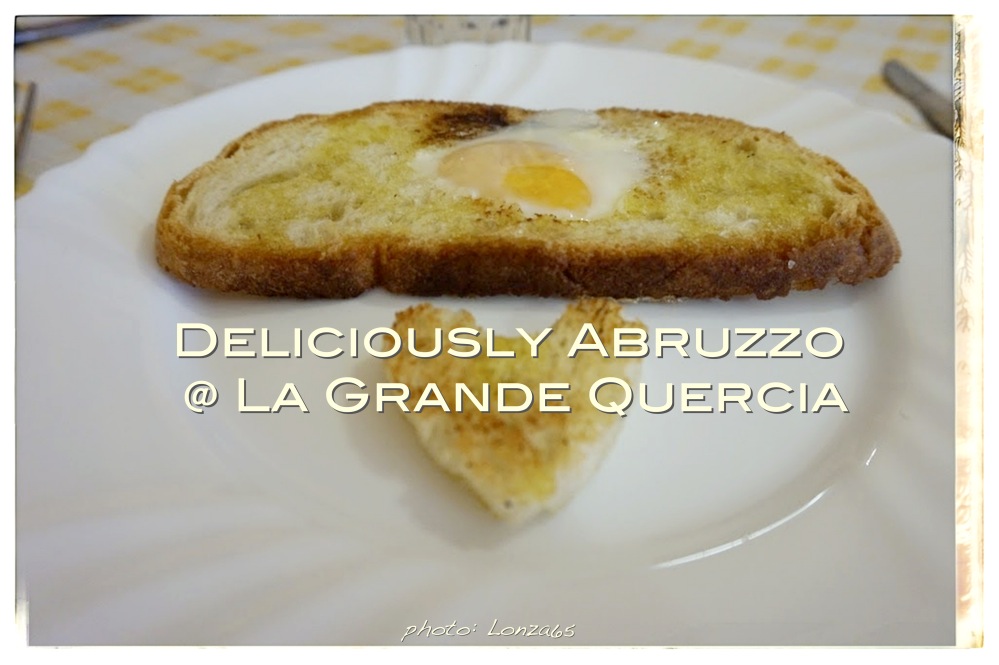
Deliciously Abruzzo @ La Grande Quercia

§03 §03 tools_grande_quercia_lonza65
Cooking tools @ La Grande Quercia | photo: ©Lonza65

At La Grande Quercia, dishes follow season cycle, so menus change according to the produce available. Don’t forget to ask for their signature lamb dish, “agnello incaporchiato” [anyello incaporkiato]. It requires a few ingredients: a leg of lamb, extra-virgin olive oil, white wine, rosemary, a couple of cloves of garlic.

§05 prep_lamb_incaporchiato_grande_quercia_lonza65
Prepping “agnello incaporchiato” @ La Grande Quercia | photo: ©Lonza65

This recipe comes from the old days when people did not have meat very often, so when there was the chance to cook it, they used to put another pot on top (incaporchiato), so that the smell could not go out and tell the neighbours that something good was on the stove. At La Grande Quercia a heavy lid is used instead, and the stewing is perfect.

§04 grande_quercia_collage_lonza65
Deliciously Abruzzo :: Mamma Maria @ La Grande Quercia | photo: ©Lonza65

The true secret is mamma Maria’s cooking mastery – and the weight of the stones…

Read more about La Grande Quercia :: Harvesting time and family recipes

La Grande Quercia :: Harvesting time and family recipes

§03 DSC_2120-01_LaGrandeQuercia_GiuseppeMarone
La Grande Quercia… | photo: ©GiuseppeMarone

Since I was a child, summer has always been the synonym for two things: school term end and harvesting time. Now that school days are – alas! – a faraway memory, harvesting time still retains its fascination to me, who I was brought up in a small village and I spent my summer vacations at my grandparents’ house in the countryside.

§05 DSC_2185-01_Collage_GiuseppeMarone
La Grande Quercia… | photo: ©GiuseppeMarone

Recently, I had the chance to watch harvesting machines at work in the countryside around Atessa, in the acreage surrounding La Grande Quercia agriturismo (farm restaurant, i.e. a business that raises, grows and cooks its own poultry, livestock and vegetables). A quintessential locavore stop.

The name comes from the majestic oak tree just in the middle of the yard – legend says that the oak offered shelter to the Borbonic troops in the XIX century – but the area surrounding the building is worth to be looked at, too. In front of you, hillsides covered with wheat, interspersed with brush spots and olive tree plots and the village of Atessa just behind your shoulders. My idea of wheat field had to be rethought: how can you call a “field” a stretch of land that is as steep as a mountain slope?

§09 IMG_1035_Collage_MateldaCodagnone_
Harvesting at “La Grande Quercia”… | photo: ©MateldaCodagnone

Nowadays harvesting is carried out by means of harvesting machines, which save time and exertion. The job a machine can do is far more quicker than a handful of toiling and sweating man. However, the spirit of this activity remains unaffected: “as you sow, so shall you reap” is to be meant literally.

DSC00317-01_honey_lonza65
Figs, raw ham, pecorino cheese and hot pepper-flavoured honey for a toothsome antipasto at “La Grande Quercia”… | photo: ©Lonza65

Lunch break at La Grande Quercia is quite and experience. My suggestion is that you should be fasting a week in advance before booking a table for a meal. Servings are copious – this is an understatement, I tell you – so stop fussing about diet, calories and alike and enjoy antipasto all’italiana, peperoncino-flavoured bread rolls, pappardelle, chitarra al ragù, and all the season suggestions… But this is another story, untill then “Bon Appetibilis”.

Two Wheels Travel Notes :: Trabocchi Coast on Bicycle

§01dd 116_trabocchi2
Trabocchi Coast on two wheels :: “…However its vulnerability is its strength: the large fishing device represents…” ~ Dacia Maraini | photo: ©MateldaCodagnone

One of the most relevant projects regarding tourism on two wheels is the Ciclovia Adriatica or Corridoio Verde Adriatico (Adriatic Bike Route), a 1,300 km bike track from Trieste to Santa Maria di Leuca. Some sections are alredy being used by cyclists, especially the ones in coast towns, and longer segments will – hopefully – be achieved in the near future on the Trabocchi coast, from Ortona to San Salvo.

!01ld DSCN1812_Punta-Aderci_Collage
Appetibilis sport contributors cycling around Punta Aderci on a spring day| photo: ©Lonza65 and ©GiuseppeMarone

For the time being, let’s enjoy some scenic ride from the main road and from some detours like the Riserva di Punta Aderci. From June to September, don’t miss the chance to stop by a trabocco and have a fish lunch on this peculiar stilt house facing the sea. Lock your bike and relax. The landscape and the food are worth the journey…

“La grande macchina pescatoria composta di tronchi intrecciati, di assi e di gomene biancheggiava simile allo scheletro colossale di un anfibio antidiluviano…. pareva vivere di una vita propria avere un’aria e un’effigie di corpo animato.” ~Gabriele D’Annunzio, Trionfo della morte


“The large fishing device, made of intertwined trunks, planks and hawsers, gleamed as a huge white skeleton of an antediluvian amphibious being… it looked as if it had a life of its own, a feeling and a shape of a living being.” Gabriele D’Annunzio, Trionfo della Morte

#PastryNotes :: “Bocconotti di Castelfrentano” A bit of Heaven

To put it bluntly, I don’t like cakes, sweets, pastries and so forth. If I needed a treat, I’d rather go for a slice of pizza, some “pane bruschettato” or some focaccia. But. (There’s always a “but” in a categorical statement as the one above). I didn’t like sweets much until someone (may he be blessed a thousand times) introduced me to a pastry tart called bocconotto.

#PastryNotes :: “Bocconotti di Castelfrentano” A bit of Heaven

Portrait of a Blacksmith: Filippo, Iron Man 72.0

In these days the Adriatic coast around Pescara is flooded with 2000+ participants to the IronMan Italy 70.3. Someone who, in a reasonable time, can swim about 2k, bike for 90k and run 21k can be regarded as an “iron” man (or woman). But someone who handles iron as if it were modeling clay and is able to create a piece of art from some scrap iron, he well deserves the name of “Iron Man”, too.

Filippo Scioli - Blacksmith in Guardiagrele, Chieti, Abruzzo photos: © Matelda Codagnone and © Lonza65

I met Filippo Scioli in his workshop in Guardiagrele, (Chieti, Italy), a mid-sized village nesting at the foot of the Maiella massif. Filippo is 72 and, when I asked him to describe himself, he just said “I am a blacksmith”. However, it is quite an understatement, since from Filippo’s anvil and hammer unique masterpieces come out. His father was a farrier and his grandfather’s job was farming tool maker. His main feature is that his artistic works (be it a dog, a rose or an andiron) do not need soldering because he just need one single piece of iron to accomplish his idea. He just need to hold some scrap iron in his hands and he knows exactly what he can obtain from it.
photo: © Lonza65
He likes to say that he is a “cittadino della Terra” (citizen of the Earth) because he does not like labels or definitions. “We’re all citizens of the Earth”, he says. And that is enough for him.

His works can be admired in Texas, Canada, Czech Republic and many other places, his presence is required at the most important arts and crafts fairs and Filippo rarely says no.

Just like the real great artists, he is not jealous of his skills, he willingly teaches everyone who is interested how to forge iron.

His workshop frequently hosts classes of students of every age, but Filippo’s eyes sparkle when he tells me about the disabled students that, on regular basis, visit his shop. “I don’t care if they don’t hit the iron, I am happy to teach them the things I can do.”

Filippo is like a river in full spate. While we talk, he is busy forging a rose with his hammer. I immediately realize that there is no noise inside the shop, but sound. And indeed, the hammer falling on the anvil creates a rhythm that Filippo composes every time he forges a new item. He says “iron talks, the hammer sings”.

You might think that this man in his Seventies is a laid-back guy. Not in the least. He radiates energy and stamina in every single move, his favorite music is country music – two cd players work at full blast in the shop and his favorite singer is Johnny Cash. This larger-than-life blacksmith is a man of parts. Besides being a talented craftsman, a big-hearted man, a great entertainer, he’s a poet, too. When the rose is finished, before we say “arrivederci”, he says these words.

photo: © Matelda Codagnone

“Come vedete, questa rosa non ha spine. Questa rosa non appassisce, non muore mai. Potremmo dire che è una rosa perfetta. Ma ahimè, al mondo niente è perfetto, anche questa ha il suo difetto. Il difetto che ha è che non profuma. Comunque, io c’ho messo il mio cuore di artigiano per farla. Chi la compra ci metterà il suo profumo.”

“As you can see, this rose has no thorns. This rose does not wither, it never dies. We can say that it is a perfect rose. But, alas, in this world nothing is perfect, this rose has its flaw. It has no smell. Anyway, I made it with all my craftsman’s heart. Whoever buys it, they will choose its fragrance.”

Next time you see some scrap iron, try to look at it with Filippo’s eyes. It may conceal a rose. And a fragrance, too.

Contact: Maestro Filippo Scioli
Mobile: +39 335 6073140
Telephone: +39 0871 86349
email: filipposcioli@email.it
Workshop: Via Occidentale, 21 – 66016 Guardiagrele (Chieti)
Tasting Notes: Cheers to the Spuma Bliss In A Hiss…!

Tasting Notes: Cheers to the Spuma Bliss In A Hiss…! When we are kids, we are used to have the same food and beverages. We are creatures of habit and we don’t like exploring new ingredients. We just stick to what we like – usually three or four dishes – and that’s it. Then, we grow up, we try new food and those flavours, tastes and smells disappear.

Last year I was at Fritto Misto All’Italiana, an annual food show focused on fried food. Regional recipes with fried ingredients are offered at stands, and even though fried food is a sort of bugbear for high-cholesterol-level people (i.e. almost everybody), visitors wolf down every single piece of food, showing no regret at all. While I was strolling around the stands, I got close the beverage stand and I saw it. Perhaps I haven’t seen it for forty years.

The cool Spuma drink... | photo: © Giuseppe Marone

My madeleine is the spuma, whose taste is hard to explain, since it is not an orange juice, it is not a coke. Nor any other popular drinks that kids usually have these days. The best thing is to try it out.

Cheers to the Spuma Bliss In A Hiss…!

My madeleine is the spuma, whose taste is hard to explain, since it is not an orange juice, it is not a coke. Nor any other popular drinks that kids usually have these days. The best thing is to try it out. As for me, when I opened the bottle, the gas hissing out of the crown cap  was like music for my years and the taste on my mouth was the taste of happiness.

I felt as if a time machine took me back when I was six and I was sipping my favourite soft drink with my cousins and my uncle. I believe that was the same feeling Marcel Proust experienced with his madeleine.

The taste that just a comfort food can give. I raised the glass and had a toast to my uncle. He used to spoil us, and needless to say, we deeply loved him. One of his treat was to take us to the local “osteria” and he would ask for a glass of wine for him and a small bottle of spuma for us kids.  He is no longer with us, but every time I drink a glass of spuma, I know he’s right beside me. Cheers to my uncle, wherever is now!

Pouring the Spuma drink | photo: ©Lonza65 and ©GiuseppeMarone

This post originally appeared in Italian on Verba Volant Il sapore della felicità (ovvero: Na onbreta par mì e na spuma pa’ i boce).